
There is a particular kind of excitement that comes with hearing someone say yes to your brand. Maybe it is a festival that wants you as a sponsor, a buyer interested in a new account, or a distributor opening a door you have been trying to reach. Suddenly, months of development begin to feel real. This is where tequila production planning starts to matter beyond operations.
Then comes the question:
“How soon can you deliver?”
That excitement can turn into pressure quickly. You look at the calendar, think about where production stands, and realize the opportunity needs product sooner than your current process allows. Tequila production planning becomes part of how you protect the opportunity, your credibility and the momentum you worked hard to create.
The issue is not that production failed. The issue is that the commercial timeline and the production timeline were moving separately.
Tequila Production Planning Starts Before the Opportunity Appears
Founders naturally focus on what is directly in front of them.
During development, founders are thinking about product, bottle, closure, label and packaging decisions. But as the brand development process moves forward, commercial considerations also need to start coming into view. Once sales begin, attention naturally shifts toward buyers, tastings, events, distributors and new accounts.
The challenge is that the business does not move in isolated stages.
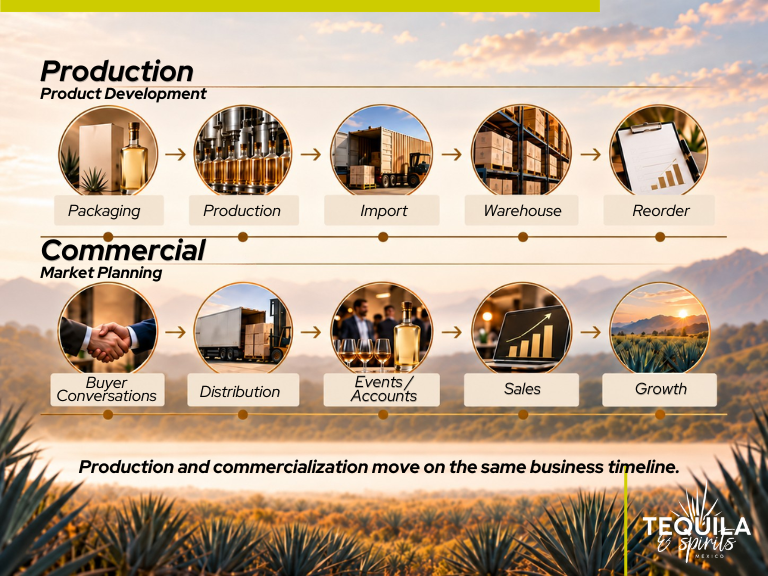
Tequila production planning affects when a brand can responsibly make a commercial commitment. At the same time, the commercial strategy should help determine when the next production needs to begin. Future market expansion can also influence decisions that have to happen earlier than many founders expect.
In one situation discussed during our team conversation, a brand was still moving through its production process when an event opportunity appeared. The event required product in roughly two weeks. The opportunity was real, but the production timeline could not simply be compressed to match it.
That is the moment when tequila production planning proves its value.
A Good Opportunity Can Still Arrive at the Wrong Time
For a founder, saying no or asking for more time can feel uncomfortable.
You have spent months trying to get people interested in the brand. When someone finally says yes, your instinct is to say yes too.
But a commercial partner does not experience the months of work behind your product. They experience the commitment you make to them. If you promise delivery by a certain date, that promise becomes part of their first experience with your business.
Good tequila production planning helps you understand what can realistically be delivered and when. It gives you enough visibility to protect the relationship instead of reacting under pressure.
Sometimes the strongest answer is not:
“Yes, we can get it there in two weeks.”
It may be:
“This is the date we can confidently commit to.”
Commercialization Does Not Begin When the Bottle Is Finished
Another mistake is assuming commercialization starts only once the finished bottles are ready.
In reality, several commercial decisions should already be moving while production is underway.
If a brand is preparing to enter the U.S. market, conversations around importation, warehousing and distribution need enough time to connect with production. This is why having access to strategic guidance throughout the development process matters: decisions made during production can influence what becomes possible when the product is ready to move toward market.
This is why tequila production planning is also business planning.
Waiting until the final bottle is ready to think about what comes next can cost valuable time. Selling aggressively without understanding when product can actually arrive creates a different risk.
The strongest position is commercial momentum supported by operational visibility. With tequila production planning, founders can work backward from realistic production and delivery dates instead of building commitments around assumptions.
The Same Problem Appears When Sales Go Better Than Expected
There is another version of this situation that can be easy to miss.
The product launches. Accounts begin ordering. Tastings go well. The founder gets busy doing exactly what every new brand hopes to be doing: selling.
Then someone asks:
“How much inventory do you have left?”
That question can change the mood instantly.
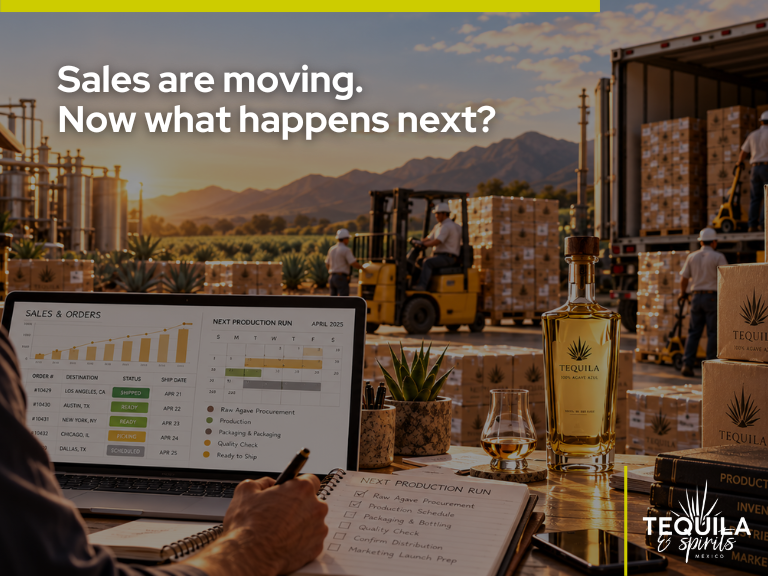
During the meeting, Jorge described a situation where a brand is selling well but becomes so focused on commercial activity that the next order has not yet been planned. If sales continue at the same pace, an out-of-stock situation may be closer than the founder realizes.
This is where tequila production planning stops being something tied only to launch. It becomes continuous.
When you are producing, someone needs to be thinking about the market. When you are selling, someone needs to be thinking about the next production.
Tequila production planning helps connect those two realities before growth creates a new operational problem.
Growth Creates New Deadlines
A growing brand has more moving pieces, not fewer.
A reorder may require new labels, packaging components, production windows and logistics coordination. Understanding how private label tequila production connects with bottling, labeling and the movement of the finished product gives founders a clearer picture of how early the next production decision may need to happen.
That is why tequila production planning should evolve with the business.
The first production is about getting to market. The second may be about responding to real demand. Later productions may have to account for new states, channels, larger accounts or a different product mix.
The timeline changes, but the principle does not. Tequila production planning should stay connected to what the market is doing and where the brand intends to go next.
Seeing the Next Stage Before You Reach It
Building a spirits brand means moving through moments where the founder’s attention is concentrated on one challenge. That is exactly where experience becomes valuable.
At TSM, the goal is not simply to move a product through production. It is to help founders understand how one stage connects with the next.
Production connects to importation. Importation connects to warehousing. Warehousing connects to distribution. Sales connect back to reorders and the next production.
Tequila production planning creates visibility across that sequence.
It does not predict every opportunity that will come your way. No one can know which buyer will call next month or which event will suddenly show interest.
What it can do is help you understand your timing, anticipate the next decision and recognize when an opportunity fits the stage your brand is in.
Planning Turns Opportunity Into Momentum
Every founder wants the message that says:
“We want your product.”
That is the moment months of work begin to connect with the market. But turning interest into momentum depends on more than reacting quickly. It depends on having enough visibility to understand what your brand can commit to today and what needs to start moving next.
That is where tequila production planning becomes part of a broader business strategy.
A clear production timeline helps commercial conversations move alongside realistic manufacturing windows, logistics, market entry and future reorders. Instead of treating each new opportunity as an isolated event, the brand can understand how it fits into the path already being built.
This is also why experience matters. At TSM, the objective is to help founders maintain visibility beyond the stage currently demanding their attention. While one part of the business is moving forward, the next one should already be coming into view.
The goal is not to predict every buyer, event or opportunity.
It is to build enough clarity that when something valuable appears, the brand can evaluate it with confidence and keep moving forward without losing sight of the bigger plan.
Because ultimately, tequila production planning is not only about when bottles will be ready. It is about connecting production with the commercial future you are building for the brand.
As CEO & Co-Founder of Tequila & Spirits Mexico, Jorge Rodríguez brings a hands-on, creative perspective to the agave spirits market. He covers emerging consumer trends, startup insights, and innovative use cases that make this industry one of the most exciting to explore.