
Many brand owners believe the hardest part of the spirits business is creating a premium liquid and getting it bottled. It is logical to assume that once a world-class product is ready, navigating U.S. alcohol distribution is just a matter of introducing it to the market. But the reality of the landscape is far less linear.
In my years accompanying brands, we’ve seen highly successful entrepreneurs watch their completed inventory sit frozen in a warehouse for eight to fifteen months. This rarely happens because of a production flaw; rather, it occurs because the commercial market demands an infrastructure that cannot be built on the fly. In the U.S. alcohol market—where regulations are often tighter than those for firearms—compliance processes do not bend. When cross-border distribution channels are not aligned from day one, a project doesn’t just stall; it triggers a domino effect where hard-earned export certificates expire, initial momentum is lost, and the market simply moves on.
The Domino Effect of Stalled Inventory
A common friction point for independent brands entering the market is the deceptive complexity of U.S. alcohol distribution and its state-level regulations. Compliance is governed by the Three-Tier System, a rigid legal framework that enforces a strict separation between producers, importers/distributors, and retailers. Without an established, pre-mapped route to market, even the most strategic founders can run into unexpected legal walls.
For instance, it is a common miscalculation to assume that holding a retail presence or a liquor license in a specific state allows a brand to bypass traditional distribution tiers and self-distribute. This approach overlooks the strict boundaries of the Three-Tier System, which legally bars producers from performing the roles of wholesalers and retailers simultaneously. Attempting to navigate the market without an authorized, state-by-state middle-tier strategy inevitably locks the inventory out of the standard commercial loop. When these structural disconnects happen, operational paralysis begins.
The damage of this delay is profoundly operational, not just financial. While inventory sits unmoved in Mexico, the strict export certificates issued by Mexican authorities continue to age, eventually expiring. Renewing these certificates requires restarting bureaucratic processes from scratch.
Simultaneously, the brand suffers from the commercial “boy who cried wolf” effect. If initial retail leads, buyers, and brand ambassadors are promised a product, but compliance delays stretch that timeline to eight or fifteen months, market confidence evaporates. The U.S. market moves rapidly. By the time the paperwork is sorted out, the window of opportunity has often closed, and the shelf space has been granted to a competitor who had their distribution infrastructure already unlocked.
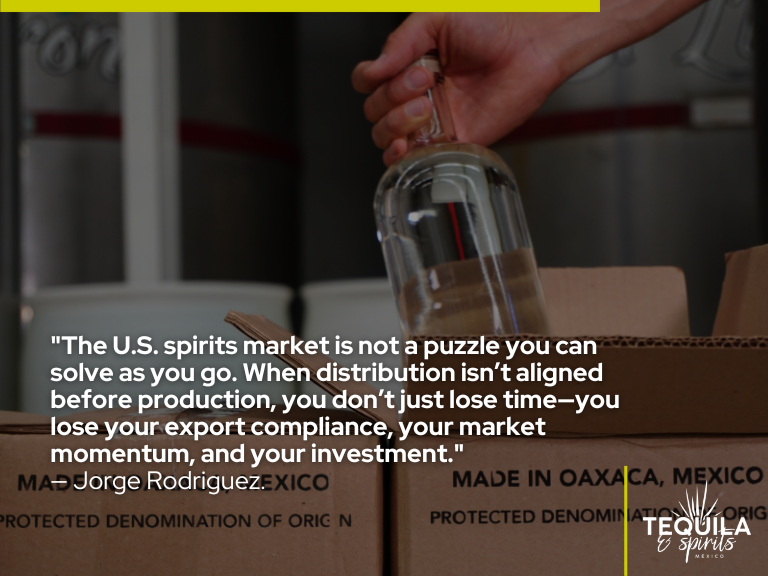
The Hidden Costs of Frozen Momentum
It is easy to initially view logistical delays as simple storage inconveniences—temporary pauses that can be resolved by paying a few months of warehouse rent. A strategic reading of U.S. alcohol distribution, however, reveals that frozen inventory acts as a silent destroyer of a brand’s foundational capital and regulatory health. Every week a shipment remains grounded, the operational risks compound exponentially, shifting from marketing challenges to structural threats.
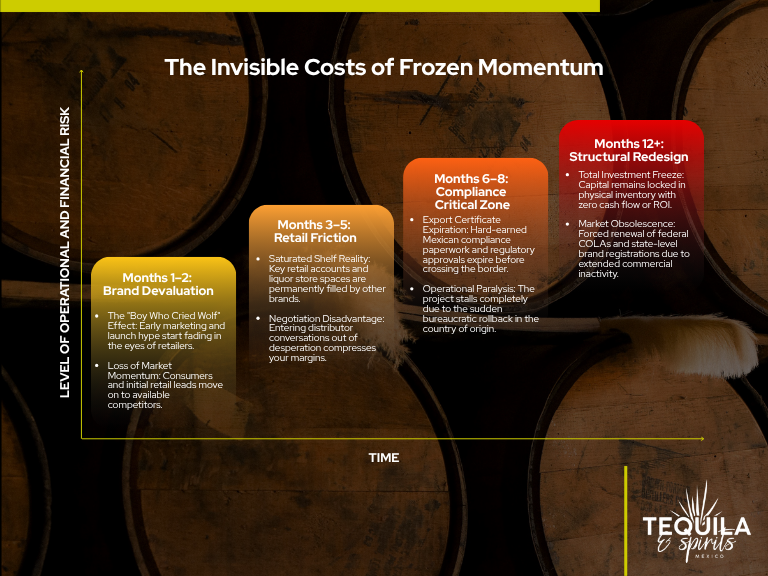
As illustrated, the initial phase of frozen momentum quietly devalues the brand’s social capital with buyers and retailers. Past the three-month mark, however, the risks escalate. Entering distributor negotiations under the pressure of holding inventory you cannot move forces brand owners to accept compressed margins and unfavorable payment terms just to unlock cash flow.
Once a delay hits the critical six-to-eight-month threshold, the project encounters severe regulatory roadblocks, beginning with the expiration of Mexican export compliance certificates. If the delay extends past a full year, the project faces market obsolescence. At this point, the operational runway is broken, requiring a fresh investment of time and capital just to return to the starting line.
Moving Past Complexity Through Proven Methodology
Navigating the transition from liquid production to cross-border placement requires adopting a synchronized timeline within the landscape of U.S. alcohol distribution. Successful agave spirit brands do not treat liquid development and commercial route planning as separate, sequential tasks. Instead, they leverage the natural manufacturing timeline of the industry to build their commercial highway.
Developing an authentic agave brand typically requires four to six months, followed by another four to five months of physical production. This structural window provides a valuable period of time. A professional methodology utilizes these months to actively build relationships with an agave spirits distribution network. Armed with physical prototypes and structural mock-ups, brand owners can pitch concrete, tangible realities to distributors and compliance partners long before the final liquid is bottled.
When a project relies on an operational partner with deep, established infrastructure in U.S. alcohol distribution, the entire dynamic shifts. Instead of wrestling with unpredictable state compliance variations or reacting to expired certificates, brand owners can let a specialized framework handle the background complexities. This alignment allows the founder to step into their true commercial role: acting as the educated, confident ambassador of their product, focused entirely on driving long-term market demand.
Build Your Brand on Grounded Expertise
A premium liquid and an elegant bottle are essential components of an agave brand, but they are only the foundation. To navigate the pressures of the U.S. commercial market, a brand must be built to move cleanly across borders and through distribution tiers from day one. True commercial longevity isn’t achieved by reacting to legal and logistical crises as they appear; it is achieved by building your business alongside partners who have already mapped out the territory.
At Tequila & Spirits Mexico, we help agave brands prepare not only for launch, but for the commercial realities that come after it. If you are building a brand for the U.S. market, our experience can help you move forward with more clarity and confidence.

As CEO & Co-Founder of Tequila & Spirits Mexico, Jorge Rodríguez brings a hands-on, creative perspective to the agave spirits market. He covers emerging consumer trends, startup insights, and innovative use cases that make this industry one of the most exciting to explore.